The Inner Wind: A Complete Guide to the 5 Prana Vayus in Yoga
You have learned the poses. You have built the practice. You show up to your mat with intention, and yet something keeps pulling you deeper. If that sounds like you, you are in the right place.
Beneath every breath, every fold, every twist, and every heart opener lives an intelligent system of energy that yoga has mapped for thousands of years. These are the Vayus, five distinct movements of Prana, or life force energy, that govern everything from how we receive nourishment to how we express ourselves in the world.
Think of Prana as the wind. Just like wind does not blow in only one direction, your life force energy moves in five unique ways within you. Each Vayu has its own purpose, its own home in the body, and its own invitation for your practice.
When we understand the Vayus, our practice stops being just physical. As a result, every inhale becomes intentional. Every exhale becomes a release, and every pose becomes a conversation with your own life force energy.
So whether you are on your mat, sitting down for a meal, or navigating a hard conversation, the Vayus are at work. Let us explore them together.
Prana Vayu: The Art of Receiving
Of all the things yoga has taught us, receiving might be the hardest one.
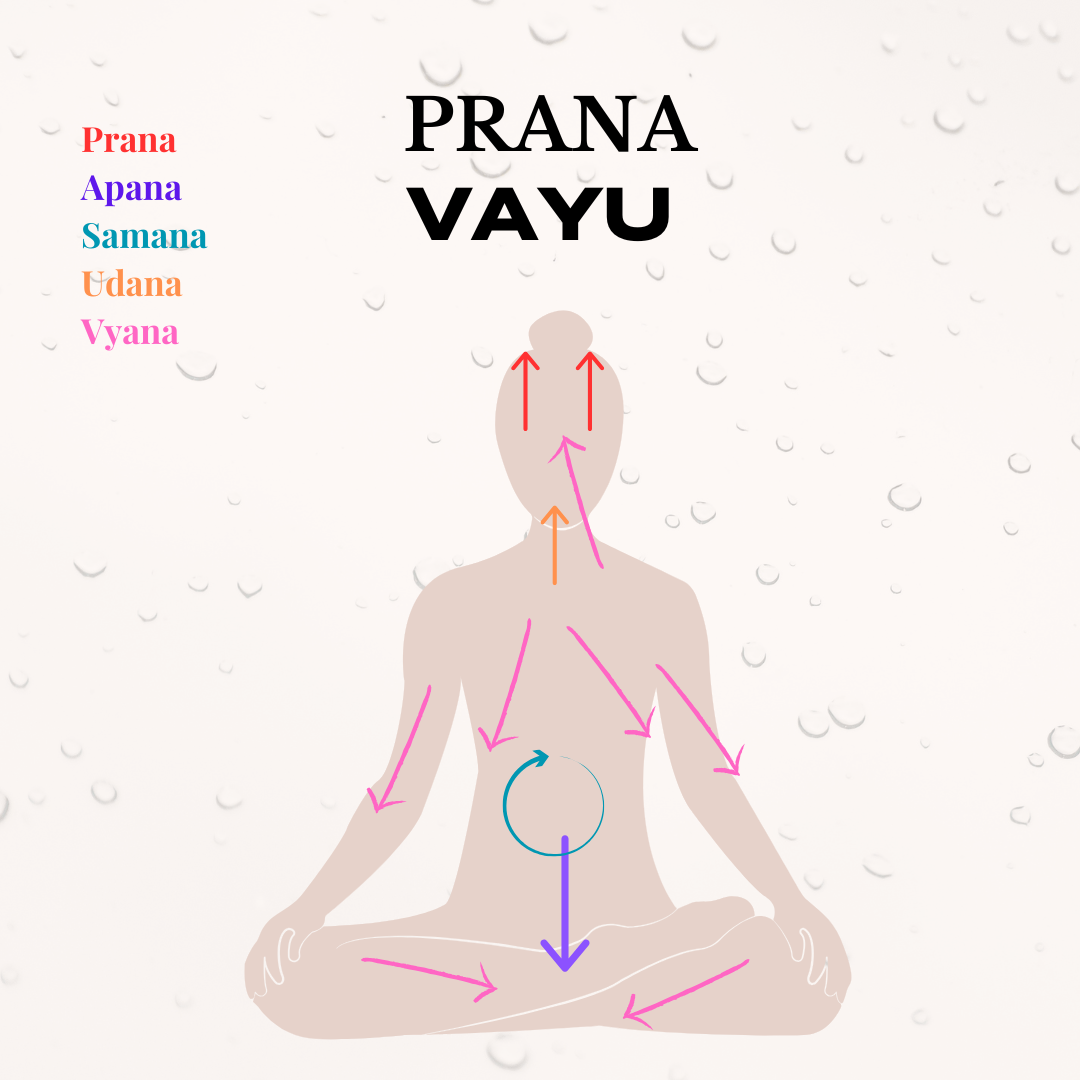
Prana Vayu is the first of the five Vayus and, in many ways, it sets the foundation for everything else. It lives in the chest and head and moves in an inward and upward direction. Its entire purpose is to draw life in. In other words, to receive.
Think of Prana Vayu as your body's welcoming force. It governs every moment of intake, including the breath entering your lungs, sunlight landing on your skin, a nourishing meal, and a conversation with a friend that fills you back up. Any time you are on the receiving end of something life giving, Prana Vayu is at work.
On the mat, this is the energy of backbends and heart openers. When we crack open the chest and lift through the sternum, we are literally creating space to receive fresh Prana. As a result, these poses become an invitation to stop bracing and start opening.
In the breath, Prana Vayu rides the inhale. The breath is the most direct carrier of Prana we have access to, and each inhale is a moment of renewal. Therefore, every breath recharges the body and mind with fresh life force energy.
The invitation of Prana Vayu is simple but profound. How well can you receive? Not just air, but nourishment in all of its forms. The more we cultivate this Vayu, the greater our capacity to take in what the world around us has to offer.
Apana Vayu: The Art of Letting Go
If Prana Vayu is the inhale, Apana Vayu is the exhale. And just like the exhale, it asks us to release.
Apana Vayu lives in the pelvis and moves in a downward and outward direction. Where Prana Vayu draws life in, Apana Vayu moves what is no longer needed out. It is the body's natural cleansing force, and it is just as sacred as receiving.
On a physical level, Apana Vayu governs all forms of elimination, including digestion, urination, menstruation, sweating, and even childbirth. Every time the body releases what it no longer needs, Apana Vayu is doing its work. This is not a lesser function. In fact, it is an essential one. Without the ability to let go, nothing new can enter.
The same is true on a mental and emotional level. In addition to its physical role, Apana Vayu also governs our capacity to release what no longer serves us mentally. Grudges, old stories, grief, and the things we are still holding onto that we know we need to put down all live here. Forgiveness lives here too.
On the mat, you will feel Apana Vayu in forward folds, yogi squat, and grounding poses that stabilize the lower body. These shapes invite surrender and ask you to soften, release the grip, and trust the ground beneath you.
In the breath, Apana Vayu rides the exhale. Notice what happens at the very bottom of your exhale, that moment where everything empties out. If you struggle to fully exhale, it might be worth asking yourself where in your life you are having trouble letting go.
The body knows how to release. Sometimes, however, we just have to give it permission.
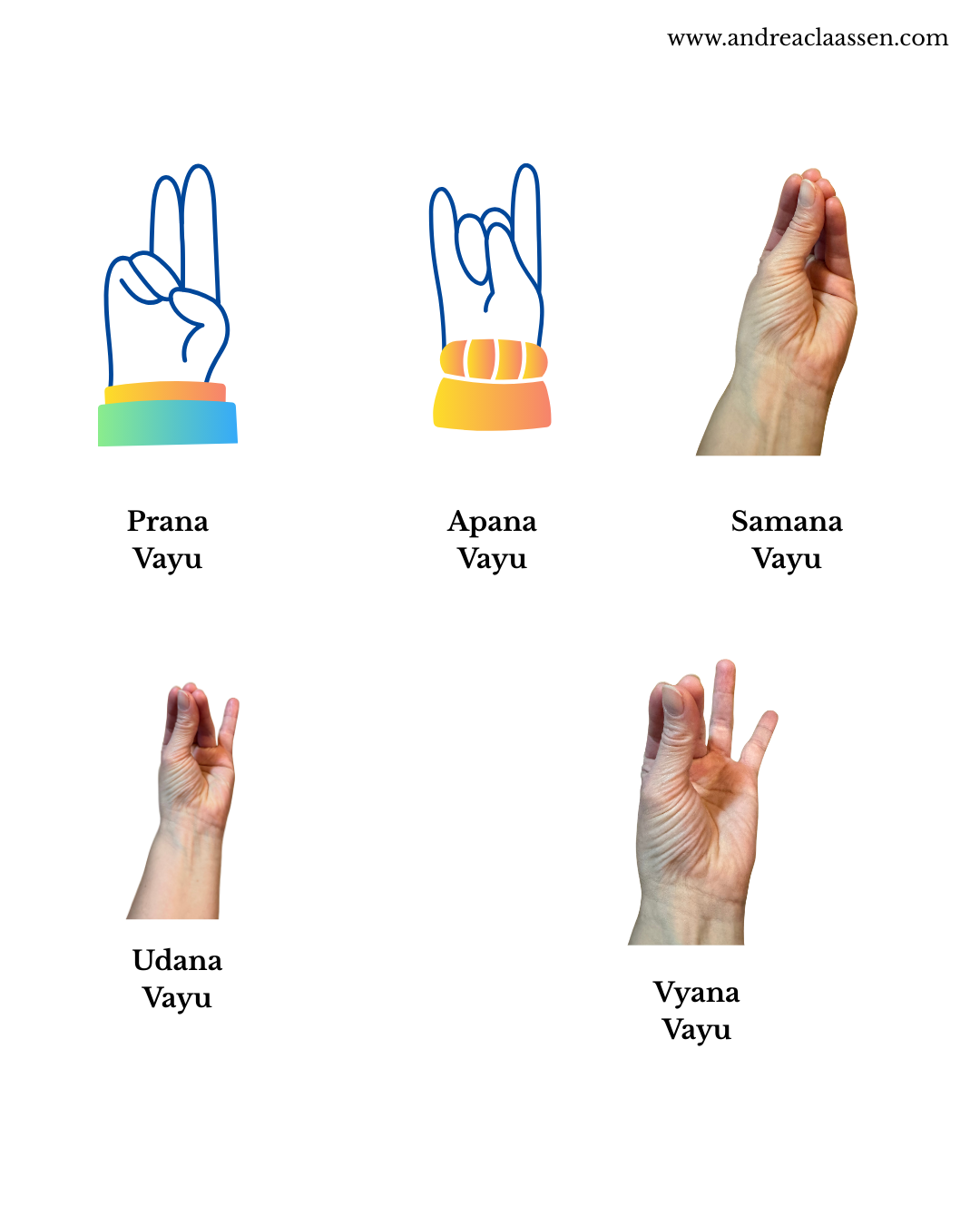
5 Vayu Mudras
Practice daily during your meditation whichever vayu you would like to invoke that day.
Samana Vayu: The Art of Integration
You have taken in. You have let go. Now comes the most quietly powerful step of all. Digestion.
Samana Vayu lives at the naval and is the great balancing force of the five Vayus. Where Prana Vayu draws energy in and Apana Vayu moves it out, Samana Vayu sits right in the middle, both literally and energetically. Its job is to take everything you have received and transform it into something useful.
On a physical level, Samana Vayu governs assimilation. It is the force behind Agni, your digestive fire, and it takes the food you eat and converts it into energy your body can actually use. Beyond digestion, though, its reach goes much further. Every experience you have ever had, every challenge, every joy, every heartbreak, Samana Vayu is the force that slowly turns those moments into wisdom.
This is the Vayu of integration, of processing, and of finding meaning in what life hands you.
On the mat, Samana Vayu lives in twists and belly down poses. These shapes literally massage the digestive organs and stoke the fire at your center. Furthermore, they bring you back to your core, both physically and energetically, and ask you to find the balance between effort and ease.
In the breath, Samana Vayu thrives in balance. Practices like Alternate Nostril Breathing, Box Breath, and Sama Vritti, where the inhale and exhale are equal, speak directly to this Vayu. When we balance the breath, we balance the nervous system. As a result, we create the inner quiet needed to actually digest our lives.
Not everything needs to be acted on right away. In fact, some things just need to be sat with. Samana Vayu teaches us that stillness is where transformation happens.
Udana Vayu: The Art of Expression
You have received. You have released. You have integrated. Now it is time to rise.
Udana Vayu lives in the throat and moves in an upward and ascending direction. It is the force of expression, the energy that takes everything you have gathered and moves it outward into the world. In other words, if Prana Vayu is the breath coming in, Udana Vayu is the voice that rides the breath out.
On a physical level, Udana Vayu governs everything that moves up and out through the throat, including speech, chanting, burping, hiccups, and even vomiting. These are all ways the body expresses, releases, and ascends in its own way. It also governs growth, which is why this energy is particularly alive and vibrant in children. Watch any child play and you will see it in action, overflowing and uninhibited.
On a mental and energetic level, Udana Vayu is the home of inspiration, enthusiasm, and aspiration. Moreover, it is the force that takes everything you have digested and processed and asks you to do something with it. To speak it, create it, move it, live it.
On the mat, Udana Vayu runs up the spine and can be activated through inversions, throat opening poses like fish pose, and chanting. For example, try chanting Om as you move from tabletop to downward dog and feel how the sound rises through you. These practices clear the channel of expression and invite Prana to move upward through the body.
In the breath, chanting is one of the most direct ways to work with Udana Vayu. The exhale becomes a vehicle for sound, and sound becomes a vehicle for energy. Therefore, every time you chant, you are literally moving Prana upward.
Udana Vayu reminds us that we are not just here to receive and process life. We are here to express it.
Vyana Vayu: The Art of Flow
Every river needs banks to flow between. Vyana Vayu is what keeps your energy moving, coordinated, and connected throughout everything.
Vyana Vayu is unique among the five Vayus because, unlike the others, it does not live in one specific location. Instead, it lives in the whole body. It is the great coordinating force, the Vayu that organizes all the other systems and makes sure everything is communicating, circulating, and working together.
Think of Vyana Vayu as your body's distribution network. It governs circulation, delivering nourishment to every corner of the body, and it keeps your systems integrated and in conversation with one another. Without Vyana Vayu, therefore, everything else falls apart. The other four Vayus depend on it to do their jobs well.
On a mental and energetic level, Vyana Vayu is the energy of adaptability. It is what allows you to move fluidly between situations, environments, and roles in your life. When this Vayu is balanced, you feel at home in your own skin no matter where you are or what is being asked of you. As a result, there is a sense of ease, of flowing freely through life rather than forcing or bracing against it.
On the mat, Vyana Vayu comes alive in lateral bends that stretch and open the full length of the body, and also in Surya Namaskar, Sun Salutations, which move Prana through every part of the body in one coordinated flow. These practices remind the body of its wholeness.
In the breath, Vyana Vayu is activated through inhale retention. Holding the breath at the top of the inhale creates a moment of full expansion, where Prana is distributed throughout the entire body before the release. It is, therefore, a beautiful practice for feeling the body as one unified, breathing system.
Vyana Vayu is the reminder that you are not a collection of separate parts. Rather, you are one intelligent, coordinated, flowing whole.
Bringing It All Together
You bite into an apple. Simple enough, right? But watch what happens beneath the surface.
Prana Vayu receives it, drawing the nourishment inward. Next, Samana Vayu breaks it down, extracting everything the body needs. Then Apana Vayu eliminates what no longer serves. Meanwhile, Vyana Vayu pushes that nourishment out to every cell in the body. Finally, Udana Vayu uses that energy to fuel your expression, your movement, your life.
This is not just digestion. This is the Vayus in perfect conversation with one another. And it is happening inside of you right now, without you having to think about it once.
That is the beauty of this system. It has always been working. Yoga, therefore, simply gives us the language to understand it and the practices to work with it more consciously.
When we understand the Vayus, we stop practicing yoga and start living it. As a result, every inhale becomes an act of receiving. Every exhale becomes an act of release, and every twist, every backbend, every moment of stillness becomes part of a much larger conversation between you and your own life force energy.
So as you move through your days and return to your mat, we invite you to get curious. Notice where energy flows freely and where it feels stuck. Also notice what you are holding onto and what you are ready to release. Consider how you receive, how you digest, and how you express.
The Vayus are not a concept to master. Instead, they are a language to learn. And the more fluent you become, the deeper your practice will take you.
This is just the beginning.
Weekly Challenge
Notice what vayu is calling your attention this week. Do you feel called to explore this more? Notice how you can bring it into your life not just this week but this entire year.
Listen + Connect
 Listen to the full episode of the Peaceful Power Podcast wherever you stream podcasts.
If this episode resonated, I’d love for you to:
-
Share it with a friend who you think might benefit from learning the art of subtle body practices
-
Leave a review to help more women find this work
-
Explore working with me through 1:1 personal training, yoga, or Ayurvedic postpartum doula support
About the host
Andrea Claassen is a yoga teacher, strength coach, and Ayurvedic practitioner with nearly two decades of experience supporting women through stress, burnout, and the perimenopause transition. By blending strength training, yoga, seasonal rhythm, and Ayurveda, she helps women feel capable, calm, and connected in their bodies.
 If this resonates, you may enjoy my 5 Day Stillness Challenge or taking my Perimenopause Support Quiz both designed to help you slow down, tune in, and reconnect with your inner rhythm during this season.